Loading...
Searching...
No Matches
binance::common::WebsocketError Class Reference
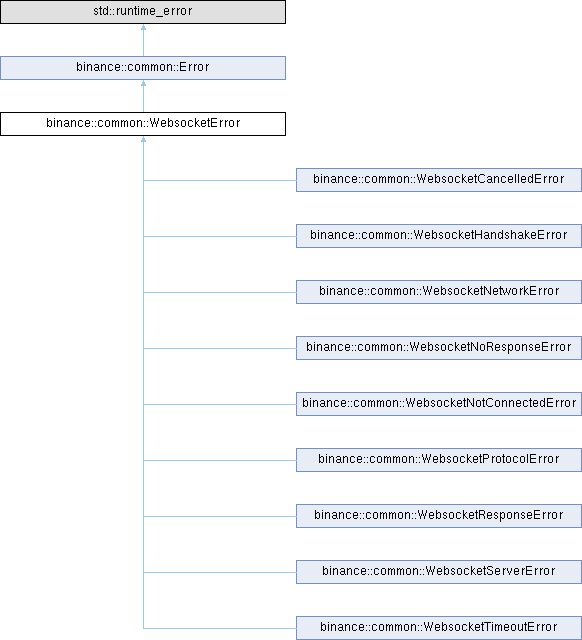
Base class of every error raised by the WebSocket clients. More...
#include <errors.hpp>
Inheritance diagram for binance::common::WebsocketError:
Public Member Functions | |
| WebsocketError (const std::string &what, bool request_sent=false) | |
| WebsocketError (const std::string &what, std::string msg, std::optional< std::int64_t > code, bool request_sent) | |
| bool | request_sent () const noexcept |
| True when the request was handed to the connection, so Binance may have executed it and the outcome is unknown. | |
| Public Member Functions inherited from binance::common::Error | |
| Error (const std::string &what, std::string msg, std::optional< std::int64_t > code=std::nullopt) | |
| const std::string & | msg () const noexcept |
| std::optional< std::int64_t > | code () const noexcept |
Detailed Description
Base class of every error raised by the WebSocket clients.
As for ConnectorError, what() is the formatted message and msg() the underlying one without the error-kind prefix; errors with no underlying message use what() for both.
Constructor & Destructor Documentation
◆ WebsocketError() [1/2]
|
explicit |
◆ WebsocketError() [2/2]
| binance::common::WebsocketError::WebsocketError | ( | const std::string & | what, |
| std::string | msg, | ||
| std::optional< std::int64_t > | code, | ||
| bool | request_sent ) |
Member Function Documentation
◆ request_sent()
|
inlinenodiscardnoexcept |
True when the request was handed to the connection, so Binance may have executed it and the outcome is unknown.
For orders, look the order up (e.g. by newClientOrderId) before sending it again.